Wednesday, March 23, 2022

Intangible Currency and a Simplified Life


When did it become virtuous to work oneself to death? Why has overcommitting and under sleeping come to mean we're "doing it right?" I'm guilty of the same thing- of finding ways to stay busy without any real intentionality. And, its exhausting. And frustrating. Because, the more we push ourselves, the more we struggle to do our tasks well. The more we succeed by the world's standards- throwing more and more balls in the air- the more we feel like we're failing, as our nearly perfect performance becomes more and more flawed with each new commitment. For Christians who are also trying to "be still" as the Bible tells us to, it's another reminder of all the things we are failing to do well. 

I've wrestled with this a lot. Because, the world measures worth in money, achievements, and busyness. In the absence of one, it makes sense that one would need to double up on another. As a stay at home mom with no significant financial contribution, aside from what I save us in would-be childcare, fast food costs, and skincare expenses, I've tried to increase my "value" in other ways. 

I have come to understand that everything is limited- time, strength, mental and physical energy- like a kind of intangible currency we spend to achieve the things we prioritize. When we spend it in one place it reduces the amount we have to use in another, and if we come up short we have to compensate by pulling from other areas. Overexerting in one area often means taking from another for a less than perfect end result. If we're mentally overworked, the task we're attempting often takes longer; if we feel exceptionally stressed in any area we often become irritable and short-tempered. It is discouraging to feel like you're completely spent and still came up short. But, how many of us feel like this every. Single. Day? Is it any wonder that some people give up trying?

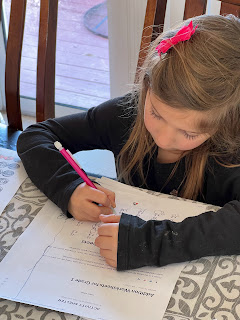
This has been one of my hard-learned lessons over the past several years- that "be still" is not another task to accomplish, but permission to pause and breathe. What is it that we are really trying to accomplish? What tasks are causing more stress than they're worth? A question that I ask a lot when it comes to homeschooling my kids is, "what is necessary and beneficial for learning, and what is busywork that can be skipped?" 

One of the reasons, I think, people get overwhelmed by the idea of homeschooling, is because school has become such a big, complex, amorphic monster. Like so many other things in our lives, education has become a construct of rules and rubrics- a check-the-boxes-to-make-sure-nothing-is-missed deity that is a necessary evil people tolerate because they have to. I think it is time to re-evaluate this perception. All of the books and computer programs, worksheets, and teaching aids are great, but they should be tools we use, not the immovable, apathetic dictator they often become. 

What do children absolutely need to know to succeed in life? Academically, they need to know how to read and write and do math. For a long time, those were the only things that were taught in school- everything else was taught at home, learning the family trade and how to keep a home. Do you know those things well enough to teach them with the help of aids? If no, are you able to find someone who can? Suddenly, the big scary monster is a manageable size, and you are free to fill in other lessons and activities that are of interest or you feel are important. This is just one example of practical simplification, and how it gives us the freedom to enjoy our work. 

"Be still" does not mean we are meant to be idle- there are many passages in the Bible that talk about the importance of work. But, I do think it means slowing down and being intentional; clearing our minds enough that we are able to be present and engaged- with those around us and with God. Perhaps that is one of the greatest gifts children give us- engaging with and teaching them necessitates that we slow down and act intentionally. When we try to get them to move at our pace there is frustration and resentment, maybe even anger; but, if we can slow down and help them at their pace without feeling the pressure to accomplish quickly, in the end we are able to accomplish so much more with minimal discord. 

And, isn't this what Jesus taught when he was on earth? More tasks, rules, and rituals does not make a person "better." Rather, it's important to focus on what really matters. In his case it was to focus on him as the only means of salvation, but the concept applies to other areas of life, also. When we understand what matters we are able to be more efficient in the work we do, and ultimately we can accomplish more with our sanity intact. 

And so, I encourage you to be still, even in your work; to be intentional, and strip your work down to what really matters. In the end, that's the most satisfying part anyway- knowing you did something that mattered, and you did it well. 

Friday, March 18, 2022

The Academic Case for Homeschooling


“…Last, but not least, every child wants to know. There they are, those desires, ready to act on occasion and our business is to make due use of this natural provision for the work of education. We do make use of the desires, not wisely, but too well. We run our schools upon emulation, the desire of every child to be first; and not the ablest, but the most pushing, comes to the front. We quicken emulation by the common desire to get and to have, that is, by the impulse of avarice. So we offer prizes, exhibitions, scholarships, every incentive that can be proposed. We cause him to work for our approbation, we play upon his vanity, and the boy does more than he can. What is the harm, we say, when all those springs of action are in the child already? The athlete is beginning to discover that he suffers elsewhere from the undue development of any set of muscles; and the boy whose ambition, or emulation, has been unduly stimulated becomes a flaccid person. But there is a worse evil. We all want knowledge just as much as we want bread. We know it is possible to cure the latter appetite by giving more stimulating food; and the worst of using other spurs to learning is that a natural love of knowledge which should carry us through eager school-days, and give a spice of adventure to the duller days of mature life, is effectually choked; and boys and girls ‘cram to pass but not to know; they do pass but they don’t know.’ The divine curiosity which should have been an equipment for life hardly survives early schooldays.” (Mason, 2017)

Charlotte Mason was a teacher in England the early 1900s. Although she taught thousands of children, in her later years she began teaching parents and caregivers on how children learn and thrive best. She stressed the importance of giving children exposure to a wide variety of ideas and experiences, and giving them the freedom to interpret the information for themselves. She believed in encouraging curiosity, and guiding self-motivated learning for the sake of understanding, rather than force-feeding information that was disconnected from the world the children lived in. She believed that all children had the capacity to learn in this way- in a society where poor children learned a trade rather than receiving a formal education- regardless of their social or economic “advantage,” because all children are born with the capacity to observe and create their own ideas accordingly.

To varying degrees, homeschool families largely ascribe to this same philosophy in the instruction of their children. While textbooks and worksheets are often used, there is a more pronounced focus on real-world, experiential learning, which is more engaging and increases retention; textbook concepts are often reinforced through practical application, so there is a better understanding of their relevance for real life. This may contribute to the results of a recent study by the National Home Education Research Institute, which concluded, “The home-educated typically score 15 to 30 percentile points above public-school students on standardized academic achievement tests.” These percentages were even more pronounced in minority students. In addition, “Research facts on homeschooling show that the home-educated are doing well, typically above average, on measures of social, emotional, and psychological development. Research measures include peer interaction, self-concept, leadership skills, family cohesion, participation in community service, and self-esteem.”

The academic advantage of homeschooling extends beyond the elementary and secondary education years. Alpha Omega Publications states, “’The high achievement level of homeschoolers is readily recognized by recruiters from some of the best colleges in the nation,” said Dr. Susan Berry, who researches and writes about educational topics like the fast growing rate of homeschooling. “Schools such as Massachusetts Institute of Technology, Harvard, Stanford, and Duke University all actively recruit homeschoolers.’”

“Educational consultant and former homeschool mom Dori Staehle recruited both homeschool and public school students in her job as a college admissions counselor. Staehle said that schools have caught on to the fact that homeschoolers represent a desirable pool of talent, often possessing impressive reading lists, letters of recommendation, AP credits, and experience in volunteering and the arts.”

Business Insider states, “…the term "homeschooling" is actually kind of a misnomer: Learning at home is only part of the equation. It's really about involving the surrounding community in raising the kids — that's when education starts to excel. Away from the standardized tests and rigid schedules in public education, kids can let their creative sides flourish, learn about the world they live in, and, when it's time, earn acceptance into the best colleges in the world.”

While homeschooled students thrive academically, in the early years and through college, public school students tend to struggle. “According to research…just under 40 percent of students score at college and career ready levels on NAEP. "College and career ready" means these scores strongly predict that students will be able to succeed doing college-level academics, or with on-the-job training in a position requiring only a high school diploma.” This contrast is shocking, especially when one considers that taxpayers pay an average of $13,000 per year, per public school student.

It is daunting to undertake a task as monumental as homeschooling, and to know that your children rely on you to prepare them for the “real world” later. However, there is a lot of evidence to support the positive outcome for students taught at home, regardless of the education level of their parents. Homeschool parents are able to give their children unparalleled attention and a much more personalized education experience than even the best overworked teacher. Children learn the most through experiences, and experiences are much easier to have with the flexibility of a homeschool environment.

Wednesday, March 16, 2022

An Introduction to Homeschooling


Homeschooling has been a somewhat ambiguous idea for most people in the past. There have been a lot of narratives pushed about the homeschool lifestyle with varying levels of credibility. Some are good, some are bad; many tend to be more of the exception than the rule. Nevertheless, the stories that have been spun lead to some confusion among outsiders as to the true nature of homeschooling. This book is an attempt to remedy that, and to encourage parents that, though daunting, homeschooling is a possible, worthwhile venture that often leads to better parent-child relationships and more well-rounded individuals.

Homeschooling, quite simply, is teaching children academic principles at home. In the early years, this often includes math, writing, and reading, along with some basic science, and maybe some art or music studies. In upper elementary school it may also include foreign language, history, grammar, logic, social studies; and high school may also include government, rhetoric, debate, home economics, financial planning, and a variety of interest-specific hobbies and classes. Core classes are often influenced by the requirements of the state, but additional classes are selected based on personal interest and the values of the individual family.

There are a variety of different approaches and curricula that parents choose to utilize with their children, but the hallmark of homeschooling is flexibility. Parents have the freedom to choose their approach to teaching, as well as their timetable for doing it; some parents adhere to the traditional nine-month school year with breaks according to the local public-school schedule, while others opt to do school year-round, three days a week, or with customized breaks for family trips or major family events, such as new babies, moves, or family emergencies.

Parents also have the flexibility to speed up or slow down at various points in accordance with their students’ abilities and weaknesses. Sometimes, children pick up on a concept very quickly and can move on; other times, they struggle, and even need to take a break, and revisit the concept at a later time. Rather than repeating a concept ad nauseum, homeschool parents have the ability to step away from it for a while, and return to it at a later date when a child is better prepared and less frustrated.

In addition, homeschool parents have the ability to change their approach if a student doesn’t seem to be grasping a concept well. This can mean supplementing with something different, or even switching to a new curriculum in the middle of the year to suit their needs. Unlike public school, where teachers are often limited in their time and resources, and forced to resort to a checking-the-boxes and memorizing-the-answers approach to learning so that students often graduate with only a rudimentary understanding of critical concepts, such as reading, writing, and math (Allen, 2016), homeschool families have the luxury of being able to alter their approach, so a concept is easier to comprehend. This individualized approach helps to ensure that students intimately learn the information for themselves, instead of “slipping through the cracks” of an over-extended, one-size-fits-all approach.

Homeschooling often focuses on quality, not quantity. A typical homeschool day is often only 2-3 hours of focused work for lower levels, and 4-5 hours for high school. This means that children have more time to explore their own interests, participate in extracurricular activities, and get more sleep. Homeschoolers do not usually have homework assignments to do, because they get all of their schoolwork done during the course of the day. This shorter, more focused, and flexible approach makes it easier for children to give their attention to their studies.

One of the most advantageous elements of homeschooling is the ability for real-world learning. Homeschool students are often involved in day-to-day household activities, as well as their studies. This means that they are educated, not only in skills necessary for employment, but also keenly aware of the responsibilities of running a home. During a school day, a student may accompany their parent to the bank and discuss the reason for the visit; they may go to the grocery store and calculate the price per ounce of a specific item; they may take an impromptu field trip to an excavation site or to the zoo.

Homeschooling is less of a “thing to do” and more of a lifestyle for many families. It’s about gently coaching students to be equipped to live confidently and competitively in the “real world” once they leave home. This includes unstructured social interactions with people of all ages and backgrounds, exposure to a variety of environments, and participation in numerous activities to challenge and stretch the child, and help them discover their talents and interests.

It is difficult to accurately describe something that is as amorphous as homeschooling. The truth is, it is as unique for each family as the family itself. Let this be an encouragement as you begin to explore the possibilities of homeschooling together. There isn’t a right or wrong way to do it. Homeschooling is very much a journey- of learning what works for your family and what doesn’t; becoming intimately acquainted with your children’s learning styles and your own approach to teaching. It’s a quest for the happy medium where the children learn, trust is built, and frustration is kept to a minimum. That is probably the hardest thing to wrap one’s mind around as a new homeschooler- kids just need to learn the basics; and, if they still love learning when that’s done, and are equipped and motivated to learn things on their own, that’s a true homeschool success story!


Want to read more? Find the book here: The Science of Homeschooling

You can buy my adventure novel for young teens here!

Thursday, March 25, 2021

Peace for a World at War


 The world is in chaos. 

Countries are firing missiles at one another; governments are struggling to control divided, and increasingly less cooperative, populations; people are up in arms against each other, and truth is evasive. 

The world needs Jesus. 

I was speaking to a friend of mine the other day, who spoke of peace as the ultimate ideal. Of course, everyone wants peace. Everyone wants to go to sleep at night knowing that they and their loved ones will wake up the next day to a world they want to live in. And yet, peace is evasive. 

Take the current border crisis, for instance. There are two main ideologies in America, and two others involved. The first, says that everyone deserves the luxuries our country has to offer, and everyone should be welcomed and treated as citizens; the second, recognizes the desperation of those who are trying to come here, but also knows that there's no way our country could care for everyone without quickly becoming like the country they were escaping from. The second group thinks it necessary to limit the number of people allowed to come to America, to protect everyone involved, and to ensure that we continue to stay in a position where we can supply humanitarian aid to others. Both groups ultimately want the same thing, but their perceived "best method" is different. Even in the quest for peace, there is conflict. 

The other two groups involved are those chasing the hope of a better life for themselves and their families, and those who are set on exploiting those who are desperately pursuing a better life. Politicians quarrel amongst themselves as to the best course of action, Americans bicker about what SHOULD be done and who should decide, and meanwhile families are torn apart and children are abducted and sold to be trafficked in our country or others. Who is the real enemy? Well, the real enemy is Satan, but we have become so nearsighted that the people we're most at odds with are our neighbors who simply don't agree on the best course of action. Even though we share a common goal.

So, what do we do? How do we fix something that is so utterly broken? The short answer is, we can't. Not alone. But, if we can begin to extend love and grace to others- as Jesus said- then things will start to change. 

Our society has decided that it's important to teach people, from the earliest age, all the way they can be hurt and just how entitled they are to lash out in pain and resentment and hate. The truth is, every one of us has been hurt; and, every one of us has hurt people we love. Every one of us has had something we said misunderstood or misinterpreted to cause unintended harm. 

Where does that leave us? If we do what we are told- and if we make sure everyone knows just how badly we have been wronged- it will lead to more hurt and more pain and more animosity. No one will ever win. Perhaps this is why Paul wrote, "Therefore, as God’s chosen people, holy and dearly loved, clothe yourselves with compassion, kindness, humility, gentleness and patience. Bear with each other and forgive one another if any of you has a grievance against someone. Forgive as the Lord forgave you. And over all these virtues put on love, which binds them all together in perfect unity." (Colossians 3:12-14)

This is a foreign concept to a lot of people, and it's becoming more so as God is forcefully removed from schools, and eradicated from more and more parts of society. 

It's an unfortunate thing, but it has been the pattern of civilizations throughout time. Since the first man and woman rebelled against God in the Garden of Eden, people and groups and dynasties have risen up under God, rejected Him, and in the midst of their demise they cry out to God and He rescues them. Those who don't cry out to God for forgiveness are destroyed. 

There is nothing "progressive" about our culture now. Sodom and Gomorrah were destroyed for similar "progressive" ideas just a few hundred years after the world was formed. People have not "evolved," they're just lost again.

The point I am trying to make, is that we have been blaming each other for things that are rooted- not in "bad blood," but in evil that has been allowed to run rampant for too long. In the Bible, Paul writes, "Finally, be strong in the Lord and in the strength of His might. Put on the full armor of God, so that you will be able to stand firm against the schemes of the devil. For our struggle is not against flesh and blood, but against the rulers, against the powers, against the world forces of this darkness, against the spiritual forces of wickedness in the heavenly places. Therefore, take up the full armor of God, so that you will be able to resist on the evil day, and having done everything, to stand firm." (Ephesians 6:10-13) 

Until we can stop treating each other with animosity, which won't be possible until our focus is on something other than ourselves, the chaos and the hatred and the pain will continue to fester and spread. 

I am praying for the heart of each and every person who reads this post- that you will know the truth, and your heart will be stirred. That you will begin to ask questions and search out the REAL answers. That your heart will be changed.

If you already know Jesus, then I pray that you will be encouraged. Because, what is happening now is nothing new. It has happened before, and God is still Sovereign. He will not be "cancelled," (historically, His Truth spreads like wildfire in the midst of oppression), and He has already won. He will bring true unity and peace to our world again. In His time. 

Whoever you are, wherever you are, I pray that the Lord will bless you and keep you, and reveal Himself to you in a very real way. "The Lord is not slow about His promise, as some count slowness, but is patient toward you, not willing for any to perish, but for all to come to repentance." (2 Peter 3:9)


Tuesday, October 6, 2020

Hope in Spite of Grief

 We lost a baby this week. It's a deep, gut-wrenching loss that I'd hoped I would never experience, but that didn't stop it from happening. It s a surreal thing- to see the baby on the ultrasound and then to know it isn't there anymore. It's a little hard to accept at times... 

I know I'm not alone. I'm just one of so many thousands of women who have miscarriages every year. It's heartbreaking to think about. The world is so full of heartbreak... 

I was blessed by a friend who came to minister to me today, and she read to me from 2 Corinthians 1- 

"Blessed be the God and Father of our Lord Jesus Christ, the Father of mercies and God of all comfort, who comforts us in all our affliction, so that we may be able to comfort those who are in any affliction, with the comfort with which we ourselves are comforted by God. For as we share abundantly in Christ's sufferings, so through Christ we share abundantly in comfort too." 

Chapter 4 goes on to say, 

"Therefore, having this ministry by the mercy of God, we do not lose heart... For what we proclaim is not ourselves, but Jesus Christ as Lord, with ourselves as your servants for Jesus' sake. For God, who said, 'Let light shine out of darkness,' has shone in our hearts to give the light of the knowledge of the glory of God in the face of Jesus Christ.

But we have this treasure in jars of clay, to show that the surpassing power belongs to God and not to us. We are afflicted in every way, but not crushed; perplexed, but not driven to despair; persecuted, but not forsaken; struck down, but not destroyed; always carrying in the body the death of Jesus, so that the life of Jesus may also be manifested in our bodies. For we who live are always being given over to death for Jesus' sake, so that the life of Jesus also may be manifested in our mortal flesh."

This is the hope that Christians have that the world doesn't understand. I have hope in the midst of heartache, because I believe that God is good, even when things happen that we don't understand. Maybe in this case it's the ability to sympathize with others who have been in this situation; maybe, it's a change in me that needed to happen. I have been so afraid, for so long, that something would happen to one of my babies that I wouldn't be able to prevent. I just can't fathom that kind of grief. I have been blessed with four beautiful babies, who I would do anything to protect; but, I lost this one, and there was nothing I could do to prevent it. 

As I left the doctors' office the other day with the knowledge of what was to come, I felt a stirring in my spirit, and a quiet, gentle voice that said, "Stop clinging so tight to things that are beyond your control. You know that I AM good, and I AM in control, and I will keep them. You need to let go."

And so, in the midst of this, though my heart still aches for the baby I didn't get to hold, I feel braver. Because I believe in the goodness of God, and that good will come from our loss, even though I may not ever know the extent of it. And, even in this, God has been merciful; He chose to use a precious unborn life instead of one of the beautiful babies that I've held and cared for and gotten to know for so many years. 

"And we know that all things work together for good to those who love God, to those who are the called according to His purpose." -Romans 8:28


Wednesday, September 9, 2020

Choosing Thankfulness


We started a new tradition this month. On September first, I hung up a tree on our wall, and we've been adding leaves to it every day with things that we're thankful for. It's fun to see what the kids want to add- to get a peek into their beautiful minds at the things that are important to them. Our four-year-old has been especially enthusiastic about cutting and coloring her own leaves, and then telling me what to write on each one. We will keep it up till after Thanksgiving. It's been a nice reminder that, even in the midst of all of the uncertainty and turmoil in the world, we still have so much to be thankful for.

As things seem to spiral further out of control, I am so thankful to know Who is ultimately in control of it all. The world is a dark, broken place, full of evil and pain(Revelation 12); but, we can have confidence and peace (though it is human to be fearful), knowing that Jesus has already conquered evil (Hebrews 2:14-18), and when He returns, it will be as a Warrior King and Judge(Revelation 19:11-21). He will bring home those who have trusted Him to save them; and, once evil is destroyed and the world is made new, we will get to rule the new earth as co-heirs to His inheritance (2 Timothy 2:12). What a beautiful gift, not only to know Who is in control, but to know that He desires such intimate fellowship with us. 

There is beauty that comes from the ashes of such devastating times, and usually it involves people searching for help, realizing that the house they've built on the sand for themselves can be washed away in the smallest storm- that they are never quite as in control of things as they like to think they are. I pray for the hearts of those who do not know Christ, and are frantically clinging to this dying world, because it's all they have. I pray that people will find hope in the promise of salvation, and in knowing that there is so much more to come after this.

I still try to control my reality and I fret about the things I'm unable to change. But, when I take a step back and look at the big picture, I am so thankful that I'm not the one who has to keep this crazy world together. This world will be destroyed. Things aren't going to get better. Until Jesus comes back and rids the world of the evil that currently poisons it.

I am thankful to know how the story ends, and I look forward to the world as it is meant to be, ruling with my Lord, forever.


Wednesday, August 26, 2020

The Gift of a Weekend


 "If you then, who are evil, know how to give good gifts to your children, how much more will your Father who is in heaven give good things to those who ask him" -Matthew 7:11

My husband and I went away for the weekend. It wasn't something we'd planned, considered, or even thought possible. But, when my brother called and asked us to share their work trip with them, we started calling grandparents to see if they could watch the kids. We even had airline points that were going to expire, so our weekend getaway ended up costing almost nothing! 

It was a wonderful weekend, and much needed; once we got there, we realized how much. Everything was perfect- the room, the ocean, the pool, the bike rides, the company... and, the cherry on top of the whole trip was the dolphin, Andre, who swam up to dock we were on to say hello, who allowed us to touch him.

And, the whole weekend we were there, I just felt loved. By my husband, certainly, but also by God. It was one of those moments where you just feel completely seen and understood and cherished. It was a reprieve from the trials, struggles, cares, and uncertainties that have been weighing us down, and we were able to reconnect and remember how much we enjoy each others' company. Truly a gift! I also got to spend the weekend with my brother- my best friend growing up- and my sister-in-law, who I now love so much more after getting to know her better and the gem she is! 

None of this was planned, or even seen as a possibility, and yet it happened to be better than we ever could have hoped! As I reflect on it now, it is a beautiful reminder of the blessing it is to know Who orchestrates all things. Even in the midst of uncertainty and fear, at the end of the day we can cling to the knowledge that we have a good God who cares for His children. 

I don't know what the future holds, but I know Who holds the future, and I know that this broken world is not all we have to live for. I know that He has promised to make all things new, and our perfect weekend doesn't even compare to what we have to look forward to. 

This weekend was a gift- an answer to an unspoken prayer. And, I am so thankful.


What's New

Teaching Fractions to the Active Child

         Fractions is a subject that causes a lot of frustration for students and teachers alike.      It’s a more abstract idea than pre...